Certification Levels
- Certified Emergency Response Officer (ERO)
- Certified Emergency Response Leader (ERL)
Each certification level has its own eligibility requirements and application process.
Eligibility for Certification
To apply for Emergency Response Certification, you must meet the eligibility requirements relevant to the certification level (ERO or ERL):
- Qualifications: Relevant emergency response qualifications aligned with national units of competency.
- Mental Wellbeing Training: Completion of Psychological First Aid, High Adversity Resilience Training (HART), or Resilience First Aid (RFA).
- Medical Training: Current HLTAID014 (Advanced First Aid) and Certificate IV in Health Care or equivalent.
- Capability: Demonstrated work experience supported by a logbook aligned to the Emergency Response Capabilities.
Access the Eligibility Form HERE or log in to the Emergency Response Dashboard to begin your application.
A Grandfathering Pathway is available until 28 February 2026. Visit the Application Requirements section for details.
Application Requirements
Applications must be submitted through the
Emergency Response Dashboard. You can save your progress and return at any time.
You will need to provide:
- Qualifications: Upload details of your relevant qualifications, including transcripts, institution, and completion dates. Include your Mental Wellbeing and Medical Training.
- Referees: Provide two referees who can verify your emergency response experience. They must be aware that they will be contacted by the assessment team.
- ESSA: You must complete and pass an Emergency Services Skills Assessment (ESSA) from an approved provider. This is valid for 3 years and is also required for recertification.
- Work Experience: Upload a current resume outlining your relevant experience.
- Logbook: ERO applicants - Minimum 12 months full-time equivalent, with at least 80 hours recorded across the 7 Emergency Response Capabilities. ERL applicants - Minimum 24 months full-time equivalent in a leadership role, with at least 160 hours recorded (80 hours at ERO level + 80 hours at ERL level).
Emergency Services Skills Assessment (ESSA)
Certification Fees
How to Apply
Emergency Response Capabilities
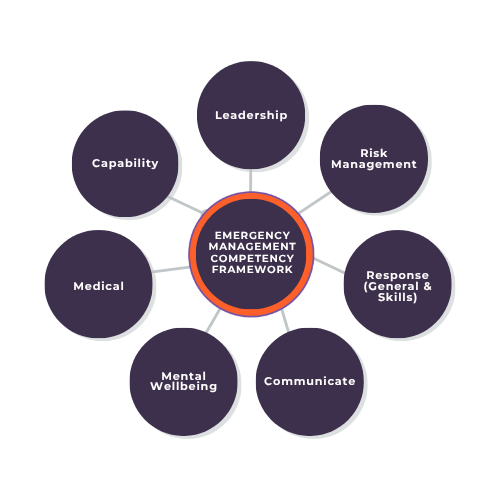
The Emergency Response Competency Framework outlines 7 key capabilities aligned with national training standards. These capabilities form the foundation of both the ERO and ERL certification pathways.
Learn more about each capability and its relevance by visiting the
Emergency Response Capabilities Webpage.
Recertification
To maintain your Emergency Response Certification, you must meet the following requirements within each 3-year cycle:
- CPD Logbook: Certified professionals are required to maintain a logbook recording a minimum of 240 Continuing Professional Development (CPD) points over a three-year period (approximately 80 points per year). Points must be earned across a range of approved activity categories, and supporting evidence must be submitted for each entry.
- CPR and Mental Health First Aid Currency: To demonstrate readiness and ongoing capability, certified professionals must hold current CPR and Mental Health First Aid certifications at the time of recertification. These typically need to be refreshed every 1–3 years depending on the provider, and proof of completion must be submitted.
- Currency of Core Qualifications: Professionals must ensure that all core qualifications used for initial certification remain current. If a unit of competency or qualification becomes obsolete or superseded, an update may be required. Guidance tools will be provided to help candidates track these changes.
Read more about the Recertification process HERE.
Grandfathering Pathway - available till 31 August 2026
Grandfathered Applicants
For those certified via the
Grandfathering Pathway (without full formal qualifications), the following is required for recertification:
- Maintain CPD logbook (240 points over 3 years)
- Show evidence of progress toward formal qualifications (e.g. Cert III, IV, or Diploma in Emergency Management)
If no progress toward a formal qualification is shown by the end of the 3-year cycle, recertification will not be granted.
Compliance and Responsibility
Certified professionals are responsible for tracking their certification status and ensuring all recertification requirements are met. Employers are encouraged to support staff in maintaining their certification.